High school (grades 11–12) · TypeLab 2D
Twin-Arch Roman Viaduct
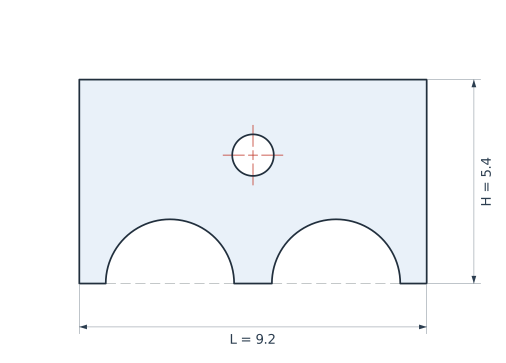
Twin-Arch Roman Viaduct: a composite plane figure made of a rectangle 9.2 × 5.4 cm, minus a semicircle of radius 1.7 cm, minus a semicircle of radius 1.7 cm, minus a circle of radius 0.55 cm. It is a classic high school (grades 11–12) geometry problem (“Calculus & Optimization”). The net area is 39.66 cm² and the total perimeter is 36.53 cm, including 3.46 cm along the inner hole.
Certified measurements (1:1 scale)
- Net area
- 39.66 cm²
- Total perimeter
- 36.53 cm
- Outer boundary
- 33.08 cm
- Hole boundaries
- 3.46 cm
- Bounding box
- 9.2 × 5.4 cm
- Basic shapes
- 4
Step-by-step decomposition
- 1.Baserectangle 9.2 × 5.4 cm49.68 cm²
- 2.−semicircle of radius 1.7 cm4.54 cm²
- 3.−semicircle of radius 1.7 cm4.54 cm²
- 4.−circle of radius 0.55 cm0.95 cm²
Area of each basic shape before the Boolean composition.
How to find the area
Area formula: A = B·H − π·r_a² − π·r₀²
Split the figure into basic shapes, find each area, add the joined parts and subtract the cut-outs: A = 49.68 − 4.54 − 4.54 − 0.95 = 39.66 cm².
Editable in PowerPoint & Office
The .PPTX file contains native DrawingML shapes: outlines, dimensions and labels stay separate objects you can recolor and edit in PowerPoint, Keynote and Google Slides. The .SVG file is pure vector art at 1:1 scale on an A4 sheet, ready for print, LaTeX and textbook layout.